
Description
The journey began by learning how to approach Scripture. After traveling through the biblical story from Genesis to Revelation, it is time to return to that question at a much deeper level.
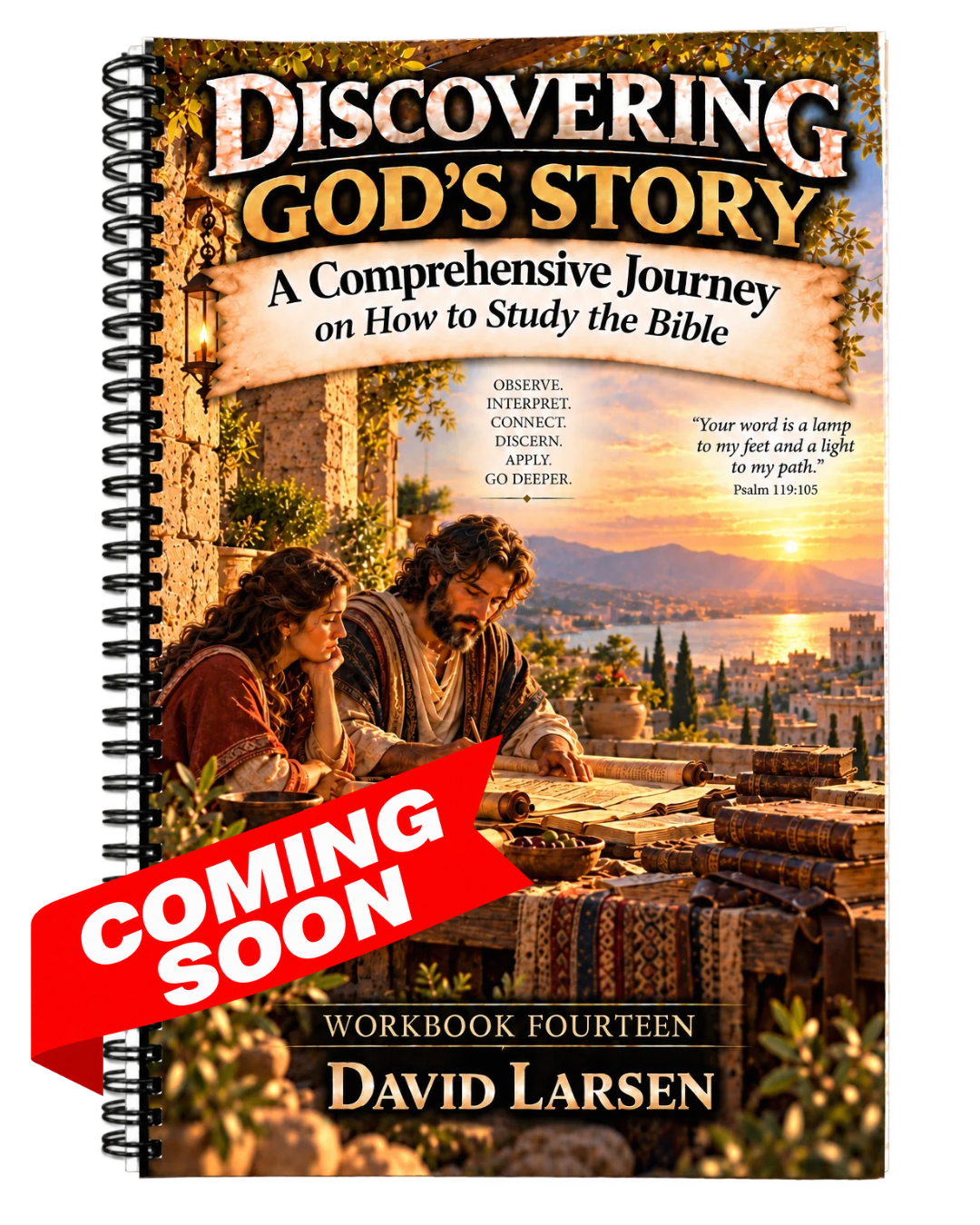
A Comprehensive Journey on How to Study the Bible brings together the principles, methods, questions, and habits needed to become a mature and discerning student of Scripture. Where Workbook 1 provides an introduction to careful Bible study, this final workbook develops those foundations more fully and equips readers to examine Scripture with greater confidence, depth, and responsibility.
The goal is not merely to accumulate more information about the Bible. It is to learn how to engage the Word of Yahweh faithfully, observing carefully, interpreting responsibly, recognizing context, tracing connections, testing conclusions, and remaining open to correction as understanding grows.
The journey begins with one of the most important disciplines in biblical study: learning to distinguish between what the text actually says and what we assume it says.
Every reader approaches Scripture with experiences, traditions, theological ideas, cultural expectations, and previously learned interpretations. Some of those may be helpful; others may prevent us from seeing what is actually present in the text. Careful study therefore requires humility, the willingness to examine not only Scripture but also the assumptions we bring to Scripture.
Observation becomes foundational.
Before asking what a passage means, readers learn to slow down and notice what is there. Repeated words, contrasts, comparisons, commands, questions, cause-and-effect relationships, literary structure, historical details, quotations from earlier Scripture, and connections with surrounding passages can all shape interpretation.
Context then becomes essential.
Words belong within sentences, sentences within paragraphs, paragraphs within books, and books within the larger biblical narrative. A verse removed from its setting can easily be made to say something its author never intended. This workbook therefore develops the habit of examining literary, historical, cultural, covenant, and canonical context before drawing conclusions.
Language receives careful attention as well.
The Scriptures were not originally written in modern English. Hebrew, Aramaic, and Greek words often carry ranges of meaning that cannot always be represented by a single English equivalent. Readers are introduced to responsible ways of exploring biblical language without assuming that every possible dictionary definition belongs in every passage.
Particular attention is given to the Hebrew foundations of Scripture and to important biblical concepts that can become obscured when separated from the world in which they were first revealed. Torah, covenant, righteousness, holiness, faith, repentance, kingdom, spirit, soul, sacrifice, atonement, and many other terms must be understood within the biblical story rather than defined only through later theological vocabulary.
The workbook also examines different kinds of biblical literature.
Narrative communicates differently from poetry. Wisdom literature asks different questions from prophetic literature. Parables, letters, apocalyptic visions, genealogies, legal instruction, songs, lament, and symbolic imagery each require readers to recognize how that form of writing communicates meaning.
Learning to identify genre helps prevent serious interpretive mistakes.
The larger biblical narrative becomes another essential interpretive tool.
After traveling through the previous workbooks, readers have seen that Scripture tells one unfolding story: creation, human rebellion, covenant, Israel, kingdom, exile, restoration, Messiah, Spirit, ekklesia, resurrection, judgment, and renewed creation.
Individual passages belong somewhere within that story.
This means interpretation cannot be reduced to asking, “What does this verse mean to me?” The better questions include: Where are we in the biblical story? What has Yahweh already revealed? What covenant setting is involved? What promises or patterns are developing? How does this passage connect with what came before and what comes after?
The workbook also explores how Scripture interprets Scripture.
Later biblical writers repeatedly draw upon earlier revelation. The Prophets reach back to the Torah. The Psalms reflect upon Israel’s history. Yahshua teaches from Moses, the Prophets, and the Writings. The apostles continually reason from Israel’s Scriptures. Revelation gathers imagery from nearly every major section of the biblical story.
Recognizing these connections allows readers to see that biblical interpretation is often already taking place within the Bible itself.
Special attention is given to quotation, allusion, patterns, themes, and typology. Readers learn to trace connections carefully without turning every similarity into a hidden prophecy or symbolic meaning.
The workbook also examines the role of worldview.
Everyone reads from within a cultural framework. Modern Western assumptions about individualism, religion, law, family, community, time, government, identity, and spirituality can differ significantly from the world of Scripture. Understanding those differences can help readers recognize meanings that are easily missed when ancient texts are unconsciously filtered through modern categories.
Tradition must also be examined.
Tradition can preserve wisdom and valuable insight, but it can also become so familiar that inherited interpretations are mistaken for the text itself. Yahshua repeatedly challenged traditions that obscured the intent of Yahweh’s instruction. Responsible Bible study therefore requires respect for those who have studied before us while retaining the freedom and responsibility to test every interpretation against Scripture.
The workbook explores the relationship between the Word and the Spirit as well.
Careful interpretation and dependence upon the Holy Spirit should never be placed in opposition. The Spirit who inspired Scripture does not lead disciples away from careful attention to what has been written. At the same time, Bible study is not merely an academic exercise.
Readers are encouraged to become men and women of both the Word and the Spirit, careful enough to test what they believe and spiritually attentive enough to allow what Yahweh reveals to produce conviction, repentance, wisdom, obedience, discernment, and transformation.
This also means learning the difference between interpretation and application.
A passage had meaning before we encountered it. We must first seek to understand what the author communicated within its original setting before asking how that truth should shape our lives today. Responsible application grows from responsible interpretation.
The workbook also addresses difficult passages and competing interpretations.
Not every question has an immediate or simple answer. Some passages contain textual, linguistic, historical, theological, or cultural difficulties. Mature study requires the ability to hold conclusions with appropriate confidence, distinguish between what is explicit and what is inferred, compare interpretations fairly, and acknowledge when Scripture does not answer every question we might ask.
This kind of humility is not weakness. It is part of learning to handle the Word responsibly.
Readers are also encouraged to use study resources wisely. Translations, concordances, lexicons, dictionaries, commentaries, historical resources, maps, timelines, and digital tools can greatly assist biblical study, but none of them should replace direct engagement with Scripture.
The question is never simply, “What does this teacher or resource say?” The question remains, “What does the text reveal, and how well does this interpretation account for the evidence?”
Throughout the workbook, readers practice the study process for themselves.
They observe passages, identify context, trace key words and themes, compare Scripture with Scripture, examine alternative interpretations, ask questions, test conclusions, and consider what Yahweh may be revealing through the text.
The purpose is not to produce disciples who depend upon someone else to tell them what the Bible means. It is to help form people who know how to search the Scriptures carefully, learn in community, receive correction, recognize the limits of their own understanding, and continue growing throughout their lives.
That responsibility also belongs within community.
Scripture was given to form a people, not merely isolated students. We need one another’s questions, insights, correction, wisdom, and experience. Studying together helps expose assumptions that might remain invisible when we read alone and reminds us that biblical knowledge is meant to produce faithful covenant life.
By the end of this workbook, the reader has come full circle.
The series began by asking how we should approach the Bible. It then traveled through the story itself, from Genesis and the Torah through the Writings, Prophets, Gospels, Acts, Paul’s letters, Apostolic Writings, and Revelation. Now the reader returns to the study of Scripture carrying the perspective gained from seeing how the whole story fits together.
But the journey is not finished.
Learning to study the Bible is a lifelong process. Every answer can lead to another question. Every connection can open another path of discovery. Greater understanding should produce greater humility, deeper obedience, and an increasing desire to know Yahweh and His Word more faithfully.
This final workbook brings the journey full circle, equipping readers not simply to know what they have been taught, but to continue seeking, examining, testing, understanding, and Discovering God’s Story for themselves.
Reviews
There are no reviews yet.